Industrial Fiber Optic Cables for Harsh Environments: EMI, Temperature & Mechanical Protection
Let's be honest: factory floors are not kind to cables.
I've spent the last eight years in this industry, and I still get calls from engineers who installed standard Telcordia-grade fiber in an industrial setting, only to have it fail six months later. Not because the fiber broke—glass doesn't care about EMI or vibration. But the cable assembly? That's a different story.
Industrial environments throw a unique combination of challenges at cabling infrastructure. High electromagnetic interference from motors and drives. Oil mist and chemical vapors hanging in the air. Temperature swings from -40°C at startup to 85°C next to a running machine. Continuous vibration from pumps and conveyors. Occasional mechanical impact from forklifts or dropped tools.
Standard indoor/outdoor cables aren't designed for this. So what is? Here's what I've learned about specifying fiber cables that actually survive on the factory floor.
What Your Cable Is Actually Fighting?
Before we talk solutions, let's walk through what industrial cables face daily:
Electromagnetic Interference (EMI): Copper cables act as antennas. In a factory with VFDs, motors, and welding equipment, that means data corruption or complete link failure. Fiber's dielectric nature makes it immune—but only if the cable assembly itself doesn't compromise that immunity with metallic components that aren't properly designed.
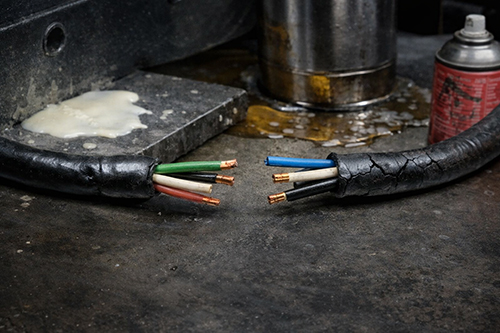
Oil and Chemicals: Cutting fluids, hydraulic oil, solvent cleaners—they're everywhere on a production floor. Standard PVC jackets soften, swell, or crack when exposed.
Temperature Extremes: A cable sitting in a warehouse at -30°C needs to flex during installation. A cable running along a steam line sees 85°C continuously. The jacket material and buffer tubes need to handle both ends of the spectrum without becoming brittle or melting.
Mechanical Stress: Continuous vibration from machinery can fatigue connectors and break fiber inside poorly designed cables. And cables get stepped on, run over, and pulled—sometimes intentionally, sometimes not.
Moisture and Contaminants: Water ingress is the silent killer. It freezes, expands, and creates micro-bends. Over time, that's link loss.
The Engineering Behind Industrial Fiber Cables
Not all "industrial" cables are created equal. Here's what separates the ones that last from the ones that don't.
Armored Construction: More Than Just Tough
For runs where mechanical protection matters, interlocked or corrugated steel armor is your friend. It sits between the fiber buffer tubes and the outer jacket. Think of it as a flexible metal shield that resists crushing forces and rodent damage.
But armor adds weight and stiffness. For applications where flexibility matters, some manufacturers use dielectric strength members like aramid yarn or fiberglass rods. They don't stop a forklift, but they handle tensile loads during pulling and provide some crush resistance.
The trade-off is real: armor protects, but it makes termination harder and adds cost. Match the protection to the risk.
Jacket Materials: The First Line of Defense
This is where most field failures start. The jacket is what sees the environment first.
| Material | Strengths | Typical Applications |
|---|---|---|
| PVC | Low cost, flexible | Indoor trays, plenum spaces |
| Polyurethane (PUR) | Abrasion resistant, flexible, good oil resistance | Robotic arms, moving machinery, exposed runs |
| LSZH | Low smoke, zero halogen | Indoor/outdoor where fire safety matters |
| Fluoropolymers | Chemical resistance, wide temp range (-55°C to 150°C) | Harsh chemical environments, high heat |
For most factory floor applications, PUR jackets hit the sweet spot. They flex well in robotic applications, resist cutting and abrasion, and handle most industrial oils. For chemical plants or extreme temperatures, fluoropolymers like FEP or PFA are worth the premium.
LSZH (Low Smoke Zero Halogen) jackets serve a different set of priorities. They excel in enclosed spaces where smoke emission and toxic gas release are safety concerns during a fire. LSZH also handles incidental oil contact, offers good UV stability for mixed indoor/outdoor runs, and performs reliably across most factory temperature ranges.
Read more: A Guide to Fire, Rodent & Corrosion Resistant Cables
Dry Water-Blocking: No Gels, No Mess
Traditional outdoor cables use grease (thixotropic gel) to block water migration. In a factory setting, that gel makes termination miserable and attracts contaminants. Dry water-blocking uses swellable tapes and yarns that expand when wet, sealing the cable internally without the mess. If you're terminating indoors, spec dry-blocked cables.
Connector Selection: The Weakest Link
Here's something I learned the hard way early in my career: you can spec the most expensive armored cable in the world, but if the connectors vibrate loose, your link fails.
In industrial settings, standard connectors need reinforcement:
M12 Fiber Optic Connectors: These are the workhorses of factory automation. The threaded coupling mechanism won't shake loose. They're IP67-rated when mated, meaning they survive washdowns and dust. They're available for both single-mode and multimode.
LC with Latching Mechanism: Standard LC connectors rely on friction. In high-vibration environments, they can work loose. Look for LC connectors with integral latches or push-pull boots that lock them into the adapter. Some manufacturers offer "ruggedized" LC designs with metal retention clips.
Environmental Sealing: If the connector sees moisture or contaminants, spec IP67-rated versions with O-rings and sealed dust caps when disconnected.
My rule of thumb: if you can't hear yourself think next to the machine, you need locked connectors.
Read more: Fiber Optic Connector Selection: Your Ultimate Type Guide
Putting It to the Test: What Validation Looks Like
Spec sheets tell you what a cable should do. Third-party testing tells you what it actually does.
The relevant standard here is IEC 60794 for optical fiber cables, with industrial extensions. A properly validated industrial cable should have test reports showing:
| Test | What It Simulates | Pass Criteria |
|---|---|---|
| Temperature cycling | -40°C to 85°C, multiple cycles | <0.2 dB added loss |
| Flexing | 10,000+ cycles over mandrel | No fiber breaks, stable loss |
| Impact | 10 impacts at 5 N·m | <0.1 dB added loss |
| Crush | 1000 N/100mm | <0.1 dB added loss |
| Oil immersion | 24 hours in industrial oil | Jacket swelling <5% |
If a supplier can't provide these test reports, ask why. The test labs (UL, ETL, Intertek) publish results—any reputable manufacturer has them.
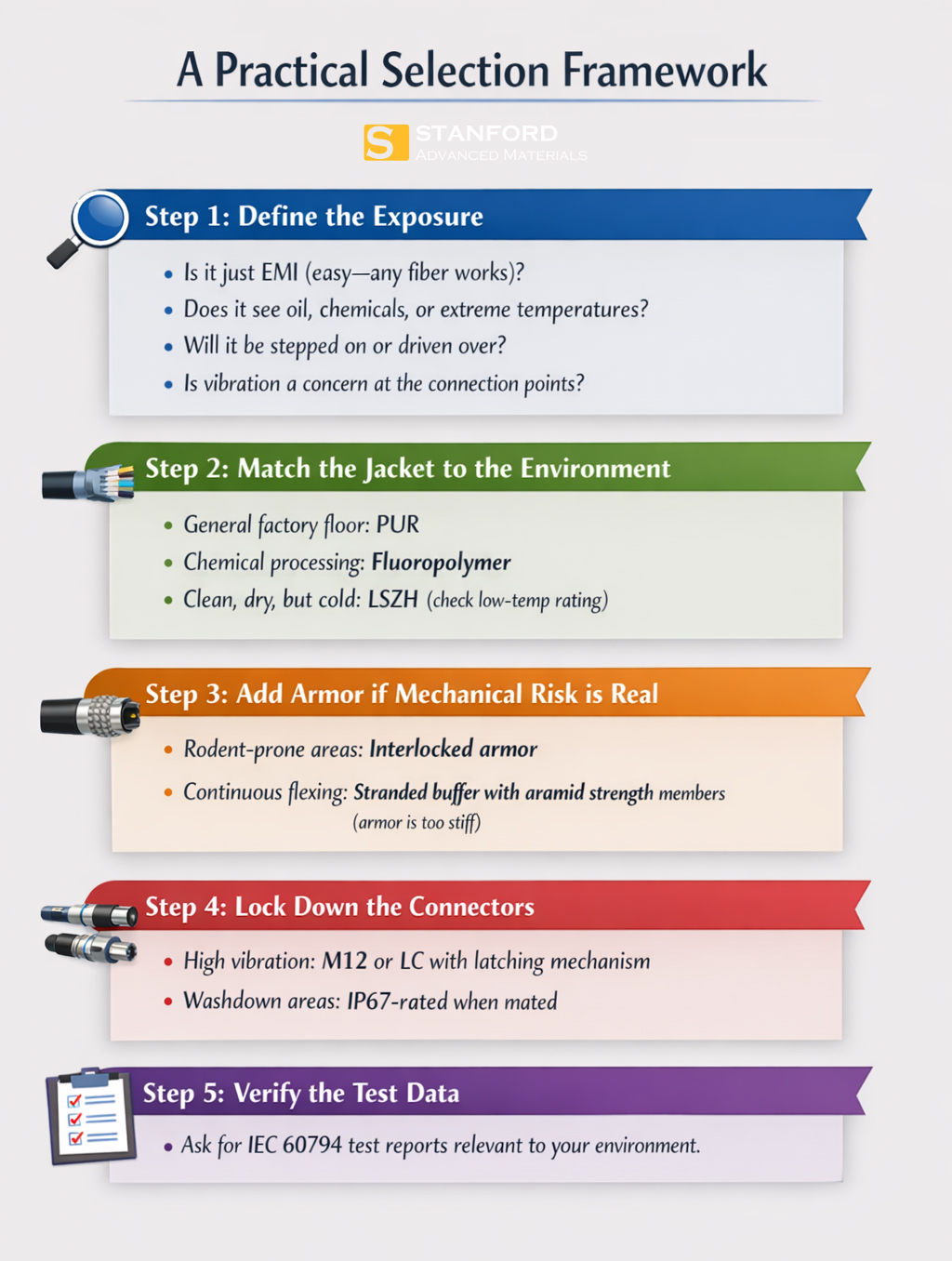
A Practical Selection Framework
What Stanford Optics Brings to the Table
At Stanford Optics, we've been supplying fiber cables to industrial clients long enough to know what works. Our industrial-grade cables are available with:
-
PUR, LSZH, or fluoropolymer jackets
-
Interlocked steel armor or dielectric strength members
-
Dry water-blocking construction
-
Pre-terminated options with ruggedized M12 or locking LC connectors
-
Full IEC 60794 test documentation available per lot
We don't sell "one-size-fits-all" because industrial environments aren't one-size-fits-all.